
7 Walk-In Cooler Temperature Maintenance Tips That Prevent Spoilage
November 02, 2026
Last Updated: November 2, 2026
Quick Summary
To maintain walk-in cooler temperature, keep the box at or below 41°F and log the reading daily to catch drift early. Clean the evaporator and condenser coils, replace cracked door gaskets, and keep product away from airflow paths. Schedule quarterly technician inspections of coils, fan motors, and controls.
- Set the target at or below 41°F for a walk-in cooler and 0°F or colder for a freezer.
- Log the temperature daily and watch the trend, since drift appears weeks before product warms.
- Test the door gasket with a dollar bill; replace it once it cracks, tears, or stops sealing.
- Clean coils with a soft brush and refrigeration coil cleaner, and never use a pressure washer.
- Have a technician inspect coils, fan motors, and controls every quarter.
Table of Contents
- Why Walk-In Cooler Temperature Drifts Over Time
- Set Up a Walk-In Cooler Maintenance Checklist You Can Actually Follow
- Clean the Evaporator and Condenser Coils on a Schedule
- Check the Door Gasket and Replace It Before It Fails
- Prevent Frost Buildup on Coils, Doors and Freezer Frames
- Troubleshooting a Walk-In Cooler That Is Not Holding Temperature
- Decide Whether to Repair, Replace a Door or Upgrade Your Box
- Frequently Asked Questions
Why Walk-In Cooler Temperature Drifts Over Time
A walk-in cooler rarely fails overnight. Its walk-in cooler temperature usually drifts for weeks before anyone notices. Most kitchens only catch it when product starts coming out warm, which is the worst time to find out.
The drift has a few common causes. Dirty coils lose heat transfer. Worn door gaskets let warm air in each time the door opens. Blocked airflow from overstocked shelves traps cold air in one corner while the rest of the box warms up.
Every one of these problems grows slowly. That is why a walk-in can run fine for months and then suddenly fall out of range. Averon Cooling Solutions builds custom walk-in boxes and doors.
Know your target range before you start. Food storage guidance commonly calls for a walk-in cooler to stay at or below 41°F and a freezer at 0°F or colder. Check the food code that applies in your area, since requirements can vary.
Set Up a Walk-In Cooler Maintenance Checklist You Can Actually Follow
A checklist only works if people use it. Keep it short enough that a line cook can finish it during a normal shift.
Start with a simple weekly and monthly split:
- Daily: Read the thermometer and log the number. Check that the door closes fully.
- Weekly: Wipe down door gaskets. Look for tears, cracks, or stiff spots.
- Monthly: Check drain lines, clear debris from the floor, and confirm shelving is not blocking airflow.
- Quarterly: Have a technician inspect the coils, fan motors, and controls.
Put the checklist on the inside of the door or right next to the thermometer. A paper log is fine. A shared spreadsheet works too.
The number matters more than the checklist itself. A logged walk-in cooler temperature trend shows drift weeks before a warm-product problem appears. Watch the trend, not just the single reading.
Clean the Evaporator and Condenser Coils on a Schedule
Dirty coils are one of the most common reasons a walk-in stops holding temperature. Dust, grease, and food debris coat the fins and block heat transfer. The compressor then runs longer to hit the same temperature, which raises energy costs and wears out parts faster.
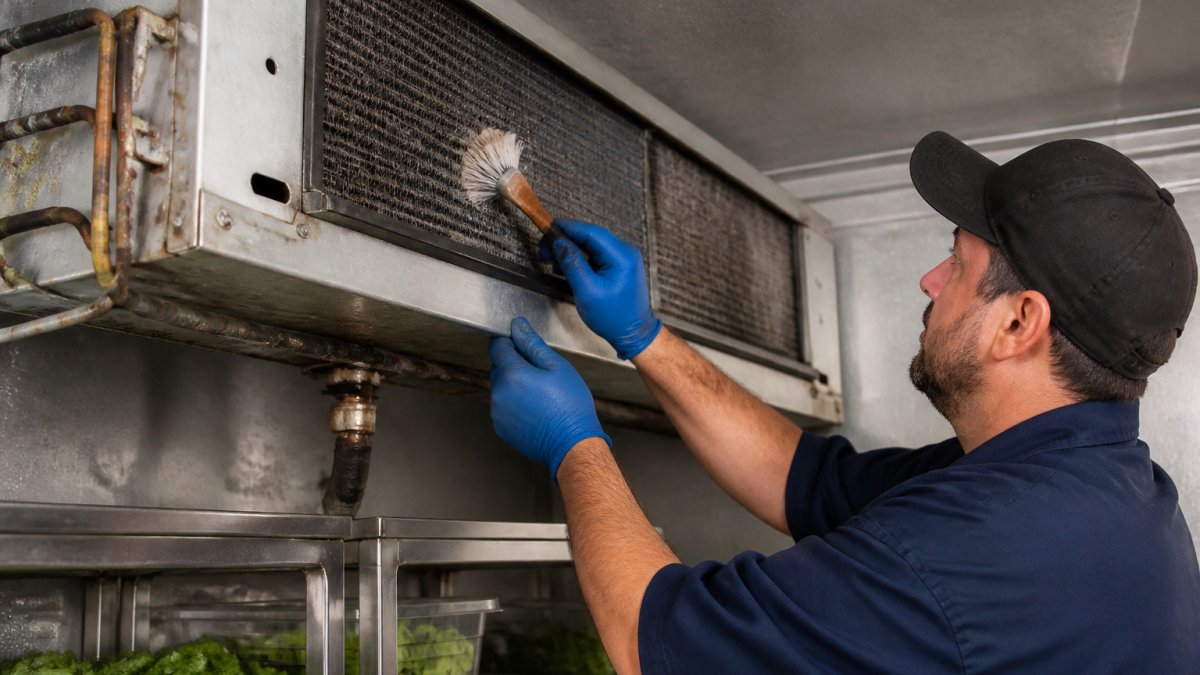
Clean the evaporator coil inside the box and the condenser coil outside it. Turn off power first. Use a soft brush and a coil cleaner made for refrigeration, then rinse or vacuum the loose debris. Never use a pressure washer, since it can bend the fins.
Clean the condenser coil more often if it sits in a greasy or dusty area. A maintenance technician should handle any work on the refrigeration system itself.
Check the Door Gasket and Replace It Before It Fails
The door gasket seals the box. A gasket with a tear or a flat spot lets warm, humid air pour in every time the door opens. That moisture then freezes on coils and frames.
Test the seal with a dollar bill. Close the door on the bill and try to pull it out. If it slides out easily along any section, that spot is leaking.
Replace a gasket once it cracks, tears, or stops sealing. Replacement is much cheaper than losing product or fixing frost damage. If the door itself is worn or damaged, a prehung replacement may be the better option. Averon's walk-in cooler replacement door in a 72" x 84" size is priced at $3,575.00, and a 72" x 84" sliding door is priced at $4,565.00. Made-to-order units ship nationwide by freight, so plan ahead.
Gasket replacement options are worth comparing before you buy. Ask whether the new gasket matches your door profile and frame style.
8' x 8' x 8' Walk-In Cooler or Freezer Box →
Prevent Frost Buildup on Coils, Doors and Freezer Frames
Frost is more than an annoyance. It insulates the coil, makes the evaporator work harder, and can seal a door shut. In a freezer, frost also signals that moisture is getting in somewhere.
Watch for these warning signs:
- Frost forming around the door frame or threshold
- Ice building up on the evaporator coil
- Doors that are hard to open or close
- Water pooling on the floor near the door
To prevent frost, keep the door gasket in good shape and avoid leaving the door open longer than needed. Make sure the defrost cycle runs properly. On freezer doors, heated frames and anti-condensate heater wire help stop ice from forming around the opening. Averon offers heated frames and replaceable anti-condensate heater wire for freezer doors, so ask about them when you order. For a deeper look, read how to prevent frost in walk-in freezers.
Do not block the evaporator fan or the coil with stacked product. Good airflow helps the defrost cycle clear ice on schedule.
Troubleshooting a Walk-In Cooler That Is Not Holding Temperature
When a walk-in stops holding walk-in cooler temperature, work through the likely causes in order. Start with the easy ones before calling a technician.
- Check the door. Look for a gasket that is torn, dirty, or not sealing. Make sure the door is not propped open.
- Check the airflow. Move product away from the evaporator fan and the return air grille.
- Check the coils. Dirty or frosted coils cannot cool well. Clean or defrost them.
- Check the thermostat setting. Confirm the setpoint has not changed by accident.
- Check the drain. A clogged drain line can cause water and ice problems.
If the box still will not cool after these steps, call a refrigeration technician. Compressor, fan motor, and refrigerant problems need professional service. Note the temperature log and any patterns, such as warm readings only at certain times of day. That history helps the technician find the cause faster.
When a walk-in stops holding temperature, the likely causes are easiest to check in this order.
| Step | What to check | Action |
|---|---|---|
| 1 | Door | Look for torn, dirty or non-sealing gasket |
| 2 | Airflow | Move product away from fan and return grille |
| 3 | Coils | Clean or defrost dirty or frosted coils |
| 4 | Thermostat | Confirm setpoint has not changed |
| 5 | Drain | Clear clogged drain line |
Decide Whether to Repair, Replace a Door or Upgrade Your Box
Not every problem needs the same fix. A failing gasket is usually a repair. A door that is warped, cracked, or frost-damaged may need full replacement. An aging box with repeated failures may be worth upgrading.
Use this simple guide:
- Repair: Gasket damage, dirty coils, minor airflow issues
- Replace the door: Warped or cracked door, frame damage, persistent leaks
- Upgrade the box: Repeated failures, a layout that no longer fits your kitchen, or higher storage needs
If you are replacing a door, measure the rough opening carefully. Averon makes walk-in boxes in custom sizes if a standard footprint does not suit your space. An 8' x 8' x 8' Walk-In Cooler or Freezer Box is priced at $8,073.00 and ships with a prehung entry door with hardware installed at the factory.

Compare the total cost of repairs over the last year against the price of a new door or box. If you are paying for repairs every few months, replacement is often the cheaper path.
Keeping your walk-in at the right temperature comes down to steady habits. Check the number, keep the seals and coils clean, and act on small problems early.
Frequently Asked Questions
What temperature should a walk-in cooler be kept at?
Most food safety guidance in the United States calls for a walk-in cooler to hold food at 41°F (5°C) or below, and a walk-in freezer at 0°F (-18°C) or below. Set the thermostat a few degrees colder than the limit so normal door openings and loading do not push product into the danger zone. Check the air temperature at the back and front of the box, because a cooler can read correctly at the thermostat while running warm near the door.
How often should you check a walk-in cooler's temperature?
Log the temperature at least twice per shift, and once at opening and once at closing is a practical minimum for most restaurants and grocery backrooms. Use a calibrated probe thermometer placed on a shelf rather than relying only on the wall display. Frequent logs make drift easy to spot: a cooler that slowly climbs over several days usually points to a coil, gasket or door problem rather than a sudden failure.
Can a damaged walk-in cooler door gasket affect temperature?
Yes. A torn, flattened or misaligned door gasket lets warm air and humidity enter every time the door closes, forcing the refrigeration system to run longer to hold setpoint. The result is higher energy use, more frost on the evaporator and temperature swings near the door. Close the door on a dollar bill: if it slides out easily at any point along the seal, the gasket needs adjustment or replacement.
How can you prevent frost buildup in a walk-in cooler?
Keep door openings short, make sure the door closes fully and seals tightly, and clean coils on schedule so airflow is not restricted. On freezer doors, a properly functioning heater wire in the frame keeps condensation from freezing around the opening. If frost returns quickly after defrosting, check the defrost timer, the door seal and the evaporator fan before assuming the refrigeration unit itself has failed.
