
Walk-In Freezer Doors for Commercial Food Storage
October 14, 2026
Table of Contents
- Understanding Walk-In Freezer Door Types and Applications
- Walk-In Freezer Door Sizes and Custom Sizing
- Prehung Walk-In Freezer Doors and Frame Configurations
- Heated Walk-In Freezer Door Frames for Frost Prevention
- Sliding vs. Hinged Walk-In Freezer Doors
- Installation, Replacement, and Retrofit Considerations
- Energy Efficiency and Long-Term Cost Savings
- Selecting the Right Door for Your Operation
- Frequently Asked Questions
Last Updated: October 14, 2026
Understanding Walk-In Freezer Door Types and Applications
Walk-in freezer doors for commercial food storage come in several configurations, each solving specific operational challenges. The right type depends on your space constraints, traffic patterns, and temperature control requirements. At Averon Cooling Solutions, we manufacture custom walk-in freezer doors built to your exact specifications, whether you're replacing an aging unit or installing new cold storage infrastructure.

Swing Doors vs. Sliding Doors
Swing doors are the most common choice for walk-in freezers because they're straightforward to install and repair.
Sliding doors move horizontally along a track mounted above the opening. They require more vertical space for the track but less clearance in front, making them ideal when your freezer entrance sits in a narrow hallway or tight kitchen corner.
The trade-off is mechanical complexity: swing doors use simple hinges and a closer, while sliding doors require track maintenance to prevent binding. Both can be equipped with heated frames to prevent frost buildup.
Plug Doors and Flush-Mount Options
A plug door fits directly into your existing frame opening without modification, making it valuable when replacing a failed door in an existing walk-in unit.
Flush-mount doors sit slightly recessed into the frame, creating a tighter seal and more finished appearance. They're used in new installations where the frame and door are engineered together, providing better insulation as an integrated system.
For most operations, the choice comes down to infrastructure: if you have a working frame and need only a replacement door, a plug door is faster and less disruptive.
Walk-In Freezer Door Sizes and Custom Sizing
Standard walk-in freezer door sizes range from 30 to 96 inches wide and 78 to 96 inches tall, but many existing spaces have non-standard rough openings.
Custom sizing is critical: a door even half an inch too small leaves gaps that destroy your thermal seal, while one too large forces expensive frame modifications.
Standard Dimensions and Measurement Guidelines
Common widths are 30, 36, 42, 48, 60, 72, and 84 inches; heights typically run 78, 84, and 96 inches. These cover most commercial kitchens, retail grocery spaces, and food service operations.
Your door size depends on your rough opening, the clear space between frame members where the panel fits, not the exterior dimensions of your walk-in box. Measure carefully, because small errors compound during manufacturing and installation.
Measuring Your Rough Opening
Measure width at the top, middle, and bottom of the opening, and take the smallest measurement as your usable width. Repeat for height at the left, center, and right.
Record the measurements and photograph the opening with a tape measure visible in the frame as reference if questions arise.
If your opening is severely out of square (varying by more than half an inch), you may need to shim the frame during installation, standard practice that doesn't require major modifications. Averon Cooling Solutions includes guidance during the pre-installation consultation.

Prehung Walk-In Freezer Doors and Frame Configurations
A prehung walk-in freezer door arrives with the panel, frame, hinges, latch hardware, and closer assembled and adjusted, eliminating field assembly and reducing installation time.
Hardware and Assembly Advantages
Prehung doors ship with NSF-rated chrome hardware suitable for freezer service.
This eliminates common installation problems: misaligned hinges cause binding, loose latches create air leaks, and incorrectly set closers slam the door or leave it hanging open.
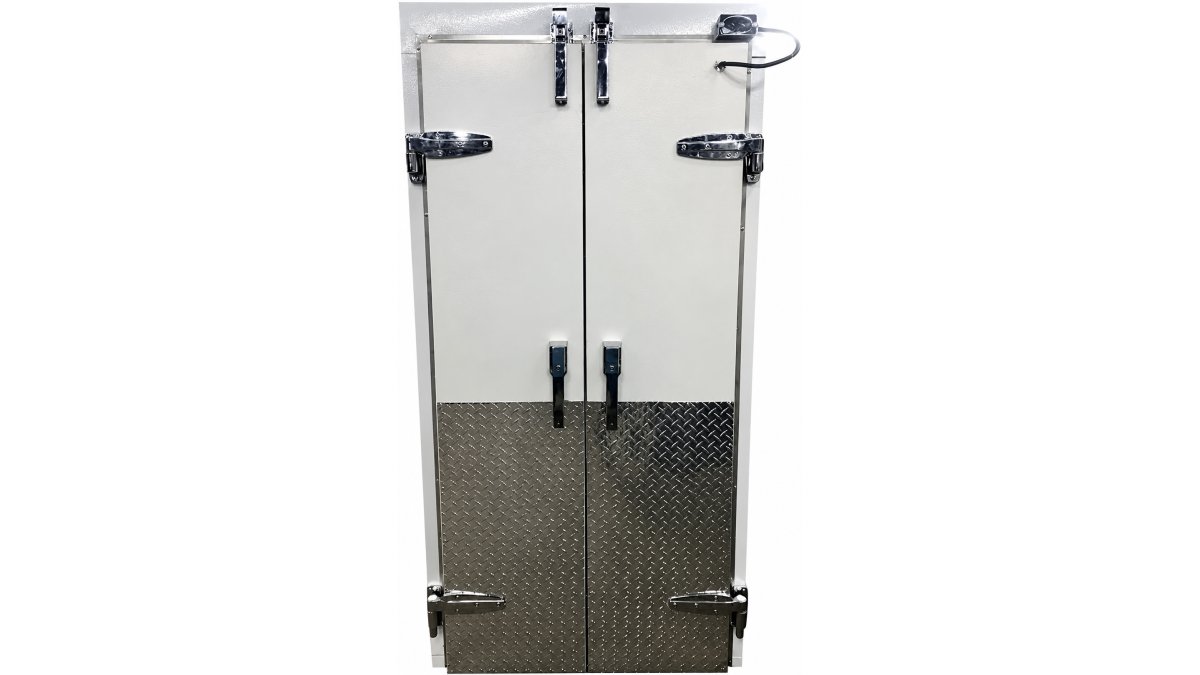
The Averon Cooling Solutions Walk-In Freezer Replacement Door 72" x 84" with Heated Frame arrives fully assembled with 26-gauge stucco-embossed steel construction, magnetic gasket with double sweep, safety-release latch, and hydraulic closer.
Heated Walk-In Freezer Door Frames for Frost Prevention
Frost buildup on freezer door frames and seals is a persistent headache in commercial cold storage: ice blocks the door from closing fully, compromises the seal, and eventually forces a shutdown for defrosting. Heated frames maintain the frame and seal above freezing even when the interior is well below zero.
How Anti-Condensate Heating Works
A heated frame contains electric resistance wire embedded in the frame members, drawing power from a standard 120-volt outlet and generating just enough heat to keep the frame surface above freezing.
A thermostat senses frame temperature: when the frame cools toward the dew point, the heater activates; once it warms slightly, the heater cycles off, preventing ice formation without running continuously.
Modern heated frames like those on the Averon Cooling Solutions Walk-In Freezer Sliding Door 72" x 78" use replaceable anti-condensate heater wire, allowing you to service the heating element without replacing the entire frame, extending door lifespan and reducing long-term maintenance costs.
Temperature-Sensitive Gaskets and Seals
The gasket, the rubber seal that compresses between door and frame, must remain flexible at freezer temperatures.
A failing gasket loses compression force, letting cold air escape and warm air infiltrate, forcing your refrigeration system to work harder.
Sliding vs. Hinged Walk-In Freezer Doors
Hinged swing doors open outward, providing full, immediate access so employees can carry items in and out without maneuvering around a mechanism. They're also mechanically simpler, with fewer failure points. The Averon Cooling Solutions Walk-In Freezer Replacement Door 72" x 96" with Plug Frame is a hinged design that works well where you have clearance in front of the opening.
Sliding doors move horizontally and require less floor space in front, essential when your freezer entrance opens into a narrow hallway or limited space. The trade-off is track maintenance to prevent binding.
Space Requirements and Kitchen Layout
A hinged door needs clearance equal to its width when fully open: a 36-inch door requires 36 inches of clear floor space. If your freezer sits in a tight corner or next to a wall, a sliding door becomes the only practical option.
Walk-In Freezer Replacement Door 72" x 84" — Prehung with Heated Frame →
Sliding doors need 8 to 12 inches of overhead clearance for the track assembly. If your ceiling is low or ductwork runs above the opening, a hinged door may be your only choice.
Traffic Flow and Operational Efficiency
In high-traffic areas like restaurant kitchens, hinged doors can become a bottleneck since staff must wait for the door to swing fully open. Sliding doors open quickly and stay out of the traffic path.
Sliding doors are also popular in retail grocery environments where customers frequently access freezer cases.
Installation, Replacement, and Retrofit Considerations
Installing a new walk-in freezer door involves more than removing the old one and bolting in a replacement: the rough opening must be clean and square, the frame properly supported, and all components aligned to ensure an airtight seal.
Retrofit Doors for Existing Units
A retrofit door fits into an existing frame without replacement, saving time and cost. Success depends on your existing frame being in acceptable condition, not cracked, severely corroded, or out of square.
Before ordering, inspect your frame for damage. Small dents are acceptable, but cracks or corrosion compromising structural integrity means you need a full frame replacement. If unsure, consult your supplier before committing to a retrofit.
Shipping and On-Site Setup
Walk-in freezer doors ship via freight carrier due to size and weight. A typical door weighs 150 to 300 pounds and requires a pallet or skid.
When your door arrives, inspect it immediately for shipping damage. Check that all hardware is present and the panel is straight and undamaged.
Install within a few days of delivery to avoid temperature swings that can affect alignment and seal integrity. Coordinate with your refrigeration technician to schedule installation when your freezer can be offline for 2 to 4 hours.
Energy Efficiency and Long-Term Cost Savings
A poorly sealed freezer door is one of the largest energy drains in commercial food service: cold air leaks out, warm air leaks in, and your refrigeration system runs continuously, adding thousands of dollars to your energy bill over a year.
Insulation and Air Leakage Control
Walk-in freezer doors are typically constructed with foam-core insulation between steel skins.
The gasket seal is equally important: a compressed gasket creates an airtight seal, but if it's loose, cracked, or compressed unevenly, you lose most of the insulation's benefit.
According to the U.S. Department of Energy's guidance on commercial refrigeration efficiency, air leakage is responsible for 20-30% of energy loss in walk-in coolers and freezers. Replacing an old door with a new one featuring a tight gasket and proper frame seal typically reduces energy consumption by 15-25%.
Operating Costs and ROI
A commercial freezer running 24/7 consumes roughly 3,000 to 5,000 kilowatt-hours per year, depending on size and ambient temperature. At $0.12 per kilowatt-hour, that's $360 to $600 annually just for the compressor.
The real savings come from reduced system wear: a system running constantly without adequate sealing fails sooner and needs more repairs. A properly sealed door means your compressor runs less and lasts longer.
Selecting the Right Door for Your Operation
Choosing the right walk-in freezer door requires matching your needs to available options. Start by identifying your primary constraint: space, traffic flow, temperature control, or budget.
Application-Specific Requirements
A busy restaurant kitchen has different requirements than a grocery store or warehouse. Restaurants need doors supporting high traffic and quick access; grocery stores need visibility while maintaining seal integrity; warehouses need heavy-duty doors that withstand frequent use and harsh conditions.
Healthcare facilities and hospitals have additional requirements around documentation and temperature monitoring.
Food production facilities may require special sanitation features, such as stainless steel construction for corrosion resistance.
Maintenance and Long-Term Durability
A quality walk-in freezer door requires minimal maintenance when properly installed. Inspect the gasket, hinges, and latch annually, and replace the gasket if you notice cracks, permanent compression, or areas that no longer compress fully against the frame.
Check hinges for looseness and lubricate annually. Adjust hydraulic closers if the door closes too quickly or slowly, and test heated frames seasonally to confirm the heater activates when the frame cools.
| Door Type | Best For | Key Advantage | Primary Consideration |
|---|---|---|---|
| Hinged Swing | Standard kitchens with floor space | Simple mechanics, full access | Requires clearance in front |
| Sliding | Tight hallways, narrow spaces | Minimal floor footprint | Track maintenance needed |
| Plug Door | Retrofit existing frames | Fast replacement, no frame work | Frame must be in good condition |
| Flush-Mount | New installations | Superior seal, integrated design | Requires frame replacement |
| Heated Frame | Freezer service | Frost prevention | Adds cost and power requirement |
Selecting a walk-in freezer door for commercial food storage is a decision that affects your operation's efficiency, safety, and long-term costs. At Averon Cooling Solutions, we build custom walk-in freezer doors manufactured to your exact specifications with prehung components, heated frames, and anti-condensate technology. Learn more about commercial refrigeration standards from the American Society of Heating, Refrigerating and Air-Conditioning Engineers.
Frequently Asked Questions
What size walk-in freezer door do I need for my commercial kitchen?
Standard walk-in freezer door sizes range from 30 inches to 84 inches wide and 78 inches to 96 inches tall, but custom dimensions are available. Measure your rough opening width, height, and depth carefully. Most commercial kitchens use 36-inch or 48-inch widths for traffic flow. Prehung walk-in freezer doors come sized to your exact specifications, so accurate measurement prevents costly installation delays and ensures a perfect fit without modifications.
How do heated walk-in freezer door frames prevent frost buildup?
A heated walk-in freezer door frame uses electric heating wire embedded in the frame and jamb to warm the door seals and frame surfaces above the dew point. This prevents condensation from freezing into ice and frost. Anti-condensate heater wire is replaceable and keeps gaskets flexible and maintains an effective weather seal.
Should I choose a sliding or hinged walk-in freezer door?
Hinged (swing) doors work best in kitchens with adequate clearance and high-traffic areas where staff carry items frequently. Sliding doors save floor space and are ideal for tight layouts or narrow aisles. Sliding doors require track systems. Consider your kitchen layout, staff workflow, and available clearance before deciding between sliding vs. hinged walk-in freezer doors.
Can I order a prehung walk-in freezer door, or do I need to assemble it myself?
Prehung walk-in freezer doors arrive fully assembled with hinges, latches, closers, gaskets, and hardware already installed and adjusted. You do not assemble them yourself. The frame is pre-fitted to your exact rough opening dimensions. Nationwide freight shipping delivers the unit ready for installation. This eliminates on-site assembly complexity and reduces installation time, minimizing downtime in your commercial kitchen or food storage facility.