
Industrial Cold Storage for Food Warehouses: A Complete Guide
October 10, 2026
Table of Contents
- What Cold Storage Warehouses Are and Why Food Businesses Need Them
- How Cold Storage Facilities Work: Refrigeration and Temperature Control Systems
- Food Cold Storage Warehouse Requirements and Compliance Standards
- Cold Storage Warehouse Temperature Requirements for Different Products
- Cold Storage Warehouse Design and Layout for Maximum Efficiency
- Walk-In Cooler Installation for Food Warehouses: Custom Solutions and Lead Times
- Energy Efficiency, Cost Management, and Temperature Excursion Prevention
- Frequently Asked Questions
Last Updated: October 10, 2026
What Cold Storage Warehouses Are and Why Food Businesses Need Them
A cold storage warehouse is a temperature-controlled facility designed to preserve perishable goods by maintaining consistent temperatures well below ambient conditions. For food businesses, cold storage is not optional, it's foundational to food safety, regulatory compliance, and operational viability.
Without proper refrigeration, bacterial growth accelerates and product quality degrades within hours. A cold storage facility prevents decay by controlling temperature, humidity, and airflow. The cold chain must remain unbroken from receiving to shipping.
The challenge is finding a solution that fits exact space, volume, and regulatory requirements. Standard modular coolers work for many operations, but restaurants with tight layouts, distribution centers, and healthcare facilities often require custom solutions.
At Averon Cooling Solutions, industrial cold storage for food warehouses is engineered to your specifications, not forced into a one-size-fits-all mold.
How Cold Storage Facilities Work: Refrigeration and Temperature Control Systems
Cold storage facilities operate through integrated refrigeration systems that remove heat from an insulated envelope. A compressor circulates refrigerant through evaporator coils inside the storage space, absorbing heat and lowering temperature. The refrigerant then moves to a condenser outside, where it releases heat to the surrounding air.
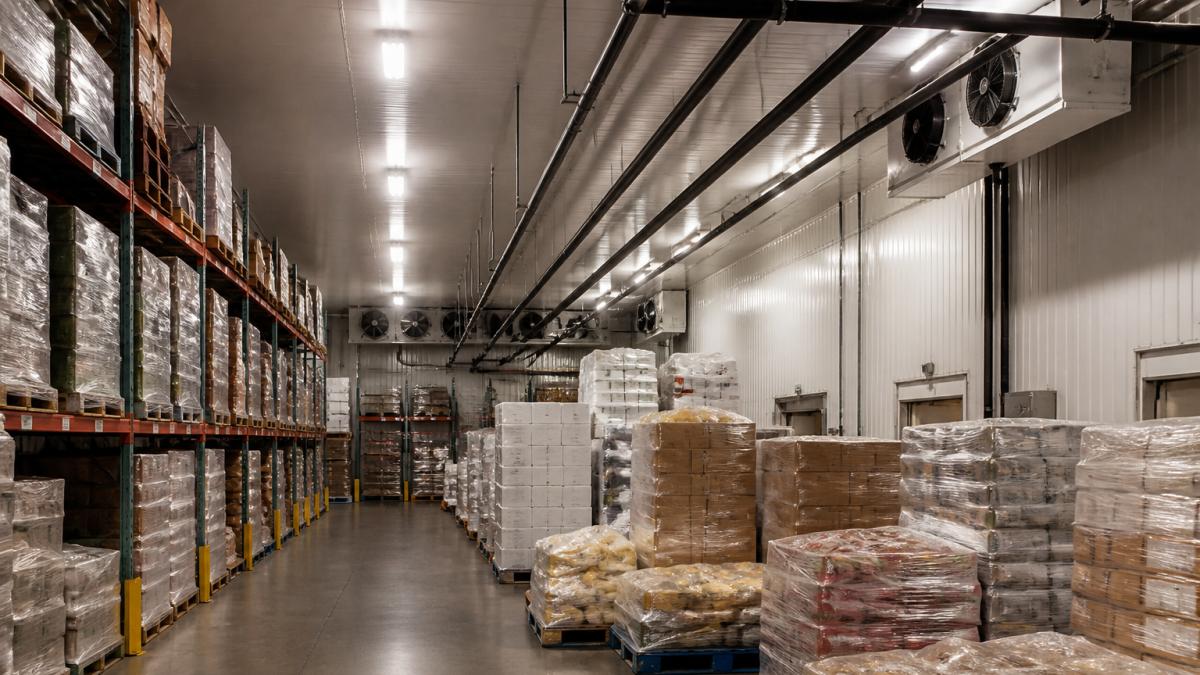
Thick polyurethane or polystyrene panels form the walls, ceiling, and floor, creating a thermal barrier that minimizes heat infiltration and energy waste.
Digital sensors and alarms alert staff if temperatures drift outside acceptable ranges. A temperature excursion, even brief, can compromise product integrity and trigger regulatory violations.
Humidity control is essential in freezer environments. Anti-condensate heater wire embedded in door frames prevents frost and ice buildup that would compromise seals.
Food Cold Storage Warehouse Requirements and Compliance Standards
Food storage facilities must comply with FDA and USDA standards. The Food Safety Modernization Act (FSMA) establishes requirements for temperature control, monitoring, and record-keeping.
Temperature Control and Monitoring Requirements
Refrigerated storage must stay between 32°F and 41°F; frozen storage requires 0°F or below. A one-degree drift accelerates bacterial growth and shortens shelf life.
Facilities must establish written procedures defining target temperature ranges, monitoring frequency (continuous digital monitoring is standard), alarm thresholds, corrective action protocols, and calibration schedules for sensors.
Documentation and Audit Readiness
Documentation is critical. Regulatory inspectors request temperature logs, maintenance records, and corrective-action reports. Facilities without proper records face citations regardless of actual conditions.
Compliant facilities must maintain continuous temperature records from automated data loggers, equipment maintenance logs, corrective action documentation, product traceability records, and staff training records.
Digital monitoring systems create audit trails automatically; manual checks do not. A facility that cannot produce 90 days of continuous temperature records will fail USDA or FDA inspection.
Regulatory Jurisdiction and Product-Specific Rules
Compliance requirements vary by product: meat and poultry require 41°F or below with USDA inspection; seafood requires 41°F or below; dairy requires 41°F or below; ready-to-eat foods require 41°F or below with separate storage from raw proteins; produce requires 45-50°F with sanitation records.
Facilities storing multiple product types must maintain separate temperature zones. Commingling raw meat with ready-to-eat foods creates compliance risk and cross-contamination liability.
Temperature Excursion Response and Liability Protection
When a temperature excursion occurs, the facility must respond immediately and document the event. A 2-hour drift to 50°F accelerates bacterial growth and creates compliance liability.
Response procedures must include immediate notification, product quarantine, root-cause investigation, corrective action, documentation, and customer notification if affected products were shipped.
Facilities with documented response procedures survive regulatory scrutiny; those without face citations and recalls.
Cold Storage Warehouse Temperature Requirements for Different Products
Meat and proteins require 28°F to 32°F; dairy requires 35°F to 38°F; produce varies from 32°F to 40°F depending on type.
Frozen goods require 0°F or colder. High-value items should be maintained at -18°F or lower to minimize degradation.
Multiple temperature zones require independent refrigeration control. Industrial cold storage for food warehouses enables custom compartmentalization to optimize conditions for each product type without oversizing.
Pharmaceutical storage requires 36°F to 46°F with minimal fluctuation. One temperature excursion can render expensive products unusable.
Cold Storage Warehouse Design and Layout for Maximum Efficiency
Facility design impacts efficiency and cost. Loading docks, receiving areas, and storage zones should minimize product handling and door-opening time.
8' x 8' x 8' Walk-In Cooler or Freezer Box →
High-density racking maximizes vertical space but requires proper airflow design to prevent hot spots. The refrigeration system must be sized for total volume with even cold-air distribution.
Door placement is critical. High-traffic areas benefit from sliding doors or double-door airlocks that minimize heat loss.
Insulated floor panels create a thermal barrier, reducing energy loss and preventing condensation.
Walk-In Cooler Installation for Food Warehouses: Custom Solutions and Lead Times
Standard walk-in coolers come in preset dimensions. Custom-built units fit exact specifications without costly modifications.
At Averon Cooling Solutions, industrial cold storage for food warehouses is manufactured to exact specifications with no modifications or wasted space.
Made-to-order units typically require 3-4 weeks from order to delivery.
Our units ship with prehung doors, hinges, latches, and gaskets pre-installed and adjusted, ready for refrigeration integration.
Heated jamb frames with anti-condensate heater wire prevent frost and ice buildup on freezer door edges.
Energy Efficiency, Cost Management, and Temperature Excursion Prevention
Energy consumption typically represents 40-60% of facility operating expenses. A poorly insulated or oversized system can double electricity costs.
Refrigeration System Sizing and Efficiency
Right-sizing the refrigeration system is essential. Oversized compressors waste energy; undersized systems cannot maintain temperatures during peak load. Proper load calculation ensures you buy exactly what you need.
Insulation and Thermal Envelope Design
Insulation quality directly impacts efficiency. High-density polyurethane panels with low thermal conductivity reduce heat infiltration.
The floor is often overlooked. A concrete floor directly on the ground conducts heat from the earth below, particularly in humid climates where ground moisture increases thermal conductivity. Insulated floor panels create a thermal barrier, reducing energy loss and preventing condensation underneath the facility.
Door Design and Air Infiltration Control
Every time a door opens, warm air infiltrates and the refrigeration system must work harder to recover. Door-opening frequency and duration are significant energy drivers in high-traffic facilities.
Energy-efficient door designs include heated door frames and anti-condensate heater wire to prevent frost and ice buildup on door edges, which would otherwise compromise seals and increase infiltration.
Total Cost of Ownership and Lifecycle Budgeting
The total cost of ownership extends far beyond the purchase price. A comprehensive budget should include:
- Equipment cost: Walk-in cooler/freezer unit, refrigeration system, controls, and installation.
- Energy cost: Estimated annual electricity consumption (in kWh) multiplied by local utility rates.
- Maintenance cost: Annual service contracts, compressor oil changes, refrigerant top-ups, gasket replacement, and sensor calibration.
- Downtime risk and product loss: A compressor failure in a facility without backup refrigeration can result in total product loss within hours. Backup systems or emergency protocols reduce this risk.
- Compliance and audit liability:
Temperature Excursion Prevention and Contingency Planning
Temperature excursions, even brief ones, trigger a cascade of problems. A 2-hour drift to 50°F in a cooler storing meat accelerates bacterial growth and shortens shelf life. More critically, it creates a compliance liability and potential product loss.
Prevention requires three layers: proper equipment, monitoring, and response procedures.
Equipment redundancy:
- Backup compressor or secondary refrigeration circuit that can maintain minimum temperatures if the primary system fails.
- Backup power supply (generator) to maintain refrigeration during utility outages.
- Redundant temperature sensors so that a single sensor failure does not go undetected.
Monitoring and alerting:
- Digital temperature sensors with alarm thresholds that trigger immediate staff notification (SMS, email, or audible alarm) when temperatures drift outside acceptable bands.
- Data loggers that record temperature every 15-30 minutes, creating a tamper-proof audit trail.
- Remote monitoring systems that allow staff to check facility conditions from off-site.
Response procedures:
- Written protocols that define what staff must do if an alarm triggers: investigate the cause, attempt to restore normal conditions, quarantine affected product, and document the event.
- Clear escalation paths: if the primary system cannot be restored within 30 minutes, activate backup refrigeration or emergency protocols.
- Product evaluation criteria: determine whether affected goods can be salvaged, sold at discount, or must be discarded based on temperature, duration, and product type.
Many food businesses view energy efficiency and temperature control as competing priorities. They are not. A well-designed facility maintains tight temperature control while minimizing energy waste. This is where industrial cold storage for food warehouses built to your specifications outperforms generic solutions: custom insulation, right-sized refrigeration, efficient door design, and redundant monitoring ensure both performance and cost-effectiveness.
Frequently Asked Questions
What temperature should a food warehouse be kept at?
Cold storage warehouse temperature requirements vary by product type. Refrigerated storage typically operates at 32°F to 45°F for fresh produce, dairy, and meat. Frozen storage maintains 0°F or below for long-term preservation. Pharmaceuticals and sensitive materials may require even tighter ranges, sometimes ±2°F. Consistent temperature monitoring prevents spoilage, bacterial growth, and food safety violations. Temperature excursions above these ranges accelerate deterioration and compromise the cold chain.
What are the main food cold storage warehouse requirements?
Food cold storage warehouse requirements include HACCP compliance, FDA food safety standards, and regular temperature monitoring with backup systems. Facilities must have proper receiving and shipping areas with minimal temperature fluctuation, sealed insulation to prevent condensation, and documented inventory management. Pallet storage must allow adequate airflow. Backup power and alarm systems are essential for temperature excursion alerts. Walk-in coolers and freezers must feature prehung components for reliable operation.
How does cold storage warehouse design and layout affect operations?
Effective cold storage warehouse design maximizes storage capacity while maintaining consistent temperatures across all zones. Strategic pallet storage placement ensures proper airflow around products, preventing hot spots. Separate receiving and shipping docks minimize door-open time and temperature loss. Loading docks should have insulated doors and vestibules. Freezer-rated hardware and heated frames on freezer doors prevent frost buildup. Custom walk-in cooler installation ensures units fit your exact rough opening, eliminating expensive modifications and reducing installation downtime for food businesses.
What should I expect during walk-in cooler installation for food warehouses?
Walk-in cooler installation for food warehouses typically takes 3-4 weeks from order to delivery via nationwide freight shipping. Prehung components with hardware installed and adjusted at the factory simplify on-site setup. Custom-built units arrive fitted to your specific dimensions, eliminating rough opening modifications. Freezer doors include heated jamb frames and anti-condensate heater wire to prevent frost. Installation requires proper electrical connection and refrigeration system integration. Averon Cooling Solutions provides made-to-order units with nationwide shipping, ensuring your facility stays operational with minimal disruption.