
Buy Custom Walk-In Cooler Online: 2026 Buying Guide
October 07, 2026
Table of Contents
- Why Buying a Custom Walk-In Cooler Online Beats Waiting on a Local Quote
- Commercial Walk-In Cooler Sizing Guide: Measure Once, Order Right
- Panels, Doors, and Refrigeration: Specifying Your Custom Walk-In Cooler
- Walk-In Cooler Installation Requirements and Site Preparation
- Walk-In Cooler Energy Efficiency Standards That Affect Your Power Bill
- What Drives Custom Pricing, Lead Times, and Shipping
- Conclusion: Ordering a Custom Walk-In Cooler Without the Guesswork
- Frequently Asked Questions
Last Updated: October 7, 2026
Why Buying a Custom Walk-In Cooler Online Beats Waiting on a Local Quote
When you buy custom walk in cooler online, you can skip some of the steps that slow down a local purchase. At Averon Cooling Solutions, we build every unit to order, so your dimensions, door swing, and refrigeration package are locked in before the panels ever hit the truck.
A made-to-order box built to your rough opening can fit better than a standard unit that a contractor has to shim and seal on site. That fit can help keep cold air where it belongs and moisture out of your walls.
The process comes down to four decisions: size, panels, doors, and refrigeration. Get those right and the rest is logistics.
Commercial Walk-In Cooler Sizing Guide: Measure Once, Order Right
Sizing is where most projects go sideways. Measure the wrong dimension and you're looking at a box that won't clear a doorway or a compressor that never keeps up. The fix is to size from the inside out: start with what you store, convert that to cubic feet, then work backward to a footprint that fits your room.
How to Measure Your Rough Opening and Interior Footprint
Measure the rough opening first, at three points: top, middle, and bottom. Use the smallest number. Walls are rarely square, and a box built to the largest measurement won't fit.
Then measure the interior footprint you need and confirm the door swing clears your aisle. A common mistake is ordering to the room's maximum dimensions and leaving no room for the door to open or for service access behind the condensing unit.
Matching Box Capacity to Your Menu and Storage Volume
Capacity is about how much product you actually hold, not how big the room looks. Walk your current storage and count what's on the shelves at your busiest hour, then add room for growth.
A practical way to convert inventory into dimensions:
- Count cases, not items. Note the case footprint (a standard full-size case is roughly 12" x 18" x 10") and how many you hold at peak.
- Convert to cubic feet. Multiply case dimensions in feet and total them. A restaurant holding 60 cases at that size needs roughly 75 cubic feet of usable storage, before shelving losses.
- Add shelving loss. Standard 18-inch-deep shelving on a 4-tier rack eats floor area but recovers vertical space. A common rule is that usable storage is about 60 to 70 percent of the box's nominal cubic volume once shelves, airflow gaps, and door swing are accounted for.
- Add growth. Most operators size for 20 to 30 percent headroom so a menu change or a busy season doesn't force a second unit.
That math usually lands a full-service kitchen in the 8' x 8' x 8' range (about 512 cubic feet nominal, roughly 320 to 360 cubic feet usable).
A few sizing rules of thumb worth writing down before you order:
- Ceiling height: 7'6" to 8'6" is standard; taller boxes cost more in panels and refrigeration load without adding much usable shelf space.
- Door width: 34 inches clears most hand trucks; 36 to 48 inches suits carts and pallet jacks.
- Aisle width: 36 inches minimum for a single worker with a cart; 48 inches if two people pass or you use a pallet jack.
Averon's 8' x 8' x 8' walk-in cooler or freezer box is a common starting point for kitchens with a standard footprint, and every box we build can be sized to your exact dimensions when the space isn't standard.

Panels, Doors, and Refrigeration: Specifying Your Custom Walk-In Cooler
Specifying a custom walk-in cooler means choosing three things that determine how well it performs: panel construction, door configuration, and refrigeration type. Each one affects your install, your power bill, and how often you're calling for service.
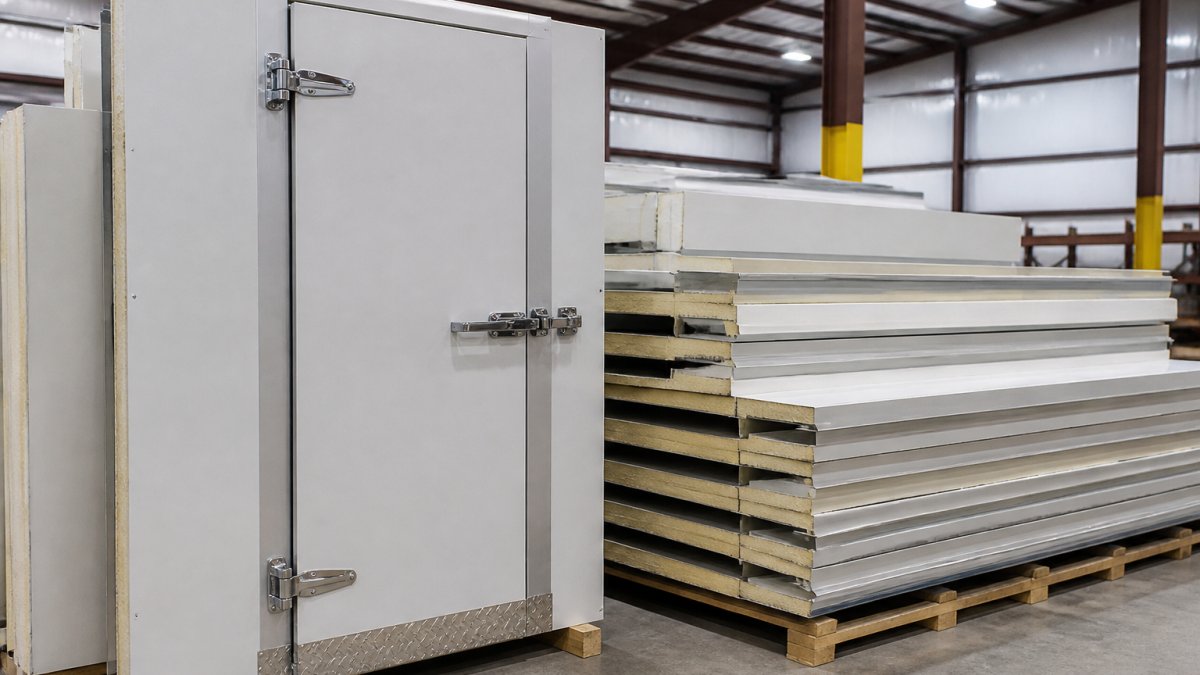
Panel Thickness, Insulation, and Metal Finish Options
Panels are the envelope. Thicker polyurethane foam can hold temperature better, while thinner panels may save money up front. For freezers, thicker panels are often recommended.
Look for tongue-and-groove panel edges that lock together with cam-action fasteners. That joint is what keeps the seal tight after years of door slams and temperature swings. Metal finish is mostly cosmetic, but it does affect cleanability in food environments.
Door Width, Hinge Side, and Self-Contained vs. Remote Refrigeration
Door width and hinge side are the two specs people forget to confirm. A 34-inch door clears most hand trucks; wider openings suit carts and pallet jacks. Hinge side determines which way the door swings into your aisle, so match it to your traffic flow.
Then pick your refrigeration:
| Option | How It Works | Best For |
|---|---|---|
| Self-contained | Condensing unit mounts on the box | Smaller boxes, simpler installs |
| Remote | Condenser sits away from the box | Larger boxes, quieter kitchens |
| Cooler | Holds above-freezing temps | Produce, dairy, prep storage |
| Freezer | Sub-zero with heated frames | Frozen goods, ice cream |
| Combination | Two zones, one footprint | Mixed menus, tight spaces |
Walk-In Cooler Installation Requirements and Site Preparation
Installation requirements start with a level, load-rated floor and a clear path from the truck to the final position. Get those two things ready and the rest of the install moves quickly.
8' x 8' x 8' Walk-In Cooler or Freezer Box →
Walk-in cooler installation requirements vary by unit, but the fundamentals hold:
- Confirm doorways and turns along the delivery route clear the largest panel
- Verify the floor is level within the manufacturer's tolerance
- Provide dedicated power to the condensing unit location
Prehung doors arrive with hinges, latch, closer, and gasketing already installed and adjusted at the factory. If you're replacing an existing door, matching your current opening specs keeps the swap simple instead of turning it into a rip-and-replace.
Walk-In Cooler Energy Efficiency Standards That Affect Your Power Bill
Energy efficiency in a walk-in comes down to three variables: insulation thickness, door sealing, and how well the refrigeration system is matched to the load. Oversize the compressor and it short-cycles.
The U.S. You can review the current rules through the DOE commercial refrigeration efficiency standards. The EPA's ENERGY STAR program also publishes guidance on commercial refrigeration efficiency that's worth checking before you specify a system.
In practice, the biggest real-world gains come from the door. A gasket that seals properly and an anti-condensate heater that keeps frost off the frame can significantly impact your bill.
What Drives Custom Pricing, Lead Times, and Shipping
Custom pricing reflects three things: the size of the box, the refrigeration package, and the door and finish options you choose. A standard 8' x 8' x 8' cooler or freezer box lists at $8,073.00, and that number moves with dimensions, temperature configuration, and whether you need an insulated floor. Here's what actually moves the number, and how the online order flow works from measurement to delivery.
What Moves the Price
| Cost Driver | What Changes | Typical Impact |
|---|---|---|
| Box dimensions | Larger footprint, more panels, more foam | Higher material cost; roughly scales with surface area, not just floor size |
| Cooler vs. freezer | Freezer-rated hardware, heated frames, thicker panels | Higher component cost; freezer panels are typically one thickness step up |
| Refrigeration type | Self-contained vs. remote | Self-contained is simpler to install; remote adds line-set, labor, and a separate condenser location |
| Door options | Width, hinge side, finish, glass vs. solid | Modest per-door change; glass doors add cost and heat load |
| Floor | Insulated floor added or omitted | Adds material and freight weight; often required for freezers on grade |
| Finish | Galvanized, white, stainless | Stainless carries a premium and is usually specified for wash-down areas |
Two cost drivers buyers underestimate:
- Freight. A walk-in ships as a palletized panel package, not a finished box. Oversize dimensions, an insulated floor, and remote refrigeration components all add weight and cube, which raises freight. Delivery to a dock with a forklift is cheaper than a residential or tight-access delivery that needs a liftgate.
- Site work. Electrical service to the condensing unit, a level pad or floor, and any local permit fees are not part of the unit price. Budget for them separately.
Lead Times
Lead times run longer than off-the-shelf units because every box is made to order. That's the trade-off: you wait for a unit that fits, instead of modifying one that doesn't. Confirm the current lead time in writing before you place a deposit, and ask whether the quoted date is ship date or delivery date.
How to Buy a Custom Walk-In Cooler Online
The online process is more structured than most buyers expect. A typical flow:
- Measure. Capture the rough opening at three points, the ceiling height, the door swing clearance, and the delivery path (doorways, turns, elevator if any).
- Specify. Choose dimensions, cooler/freezer/combination, panel thickness, door width and hinge side, floor, finish, and refrigeration type.
- Submit a design or quote request. Most manufacturers ask for your measurements and a sketch; some offer a configurator that returns a dimensioned drawing.
- Review the submittal. You should receive a drawing showing panel layout, door location and swing, and refrigeration placement. Check it against your sketch before approving.
- Confirm the order. Deposit, signed submittal, and a confirmed ship window. Ask what the cancellation and change-order policy is before you sign.
- Prepare the site. Electrical rough-in, level floor, and clear delivery path ready before the truck arrives.
- Receive and install. Freight delivers to your dock; panels are labeled and prehung components cut installation time once it lands.
Conclusion: Ordering a Custom Walk-In Cooler Without the Guesswork
The hard part of buying a walk-in isn't the purchase, it's getting the measurements, door swing, and refrigeration spec right the first time.
Averon Cooling Solutions builds every walk-in to your rough opening, ships it prehung with hardware installed and adjusted, and offers freezer-rated options like heated frames and replaceable anti-condensate heater wire to keep frost off the door.
Get a quote from Averon Cooling Solutions and order a box built to your dimensions, not one you have to make work.
Frequently Asked Questions
What should I consider before buying a custom walk-in cooler online?
Start with your rough opening dimensions, since a custom walk-in cooler is built to fit the exact space you have. Then confirm whether you need a cooler, freezer, or combination unit, because that determines panel thickness and door hardware. Decide between self-contained and remote refrigeration, and check ceiling height for the condensing unit. Finally, ask about lead time, freight shipping, and who handles installation before you place the order.
How do I measure my space for a custom walk-in cooler?
Measure the rough opening at its narrowest point, plus the full length, width, and ceiling height of the available footprint. Note any obstructions such as pipes, sprinkler heads, or electrical panels that would block panel assembly. Record door swing clearance so the entry door can open fully. Send those numbers with a photo of the space when you request a quote, and the manufacturer can confirm whether a standard size fits or a made-to-order box is required.
Are online custom walk-in coolers shipped pre-assembled?
Walk-in boxes ship as modular insulated panels with cam-lock fasteners, not as a single assembled unit. That is what makes nationwide freight shipping practical. Entry doors typically arrive prehung, with hinges, latch, closer, and gasketing installed and adjusted at the factory, which cuts on-site labor. Expect to assemble panels on a level floor and connect the refrigeration package, or hire an installer to handle the full build.
What are the energy efficiency standards for commercial walk-in coolers?
Commercial walk-in coolers sold in the United States must meet the federal energy conservation standards administered by the Department of Energy, which set maximum annual energy use based on box size and type. Meeting the minimum is not the same as running efficiently. Panel thickness, door gaskets, anti-condensate heater controls, and correctly sized refrigeration all affect real power draw, so ask for the rated specifications before you buy.